


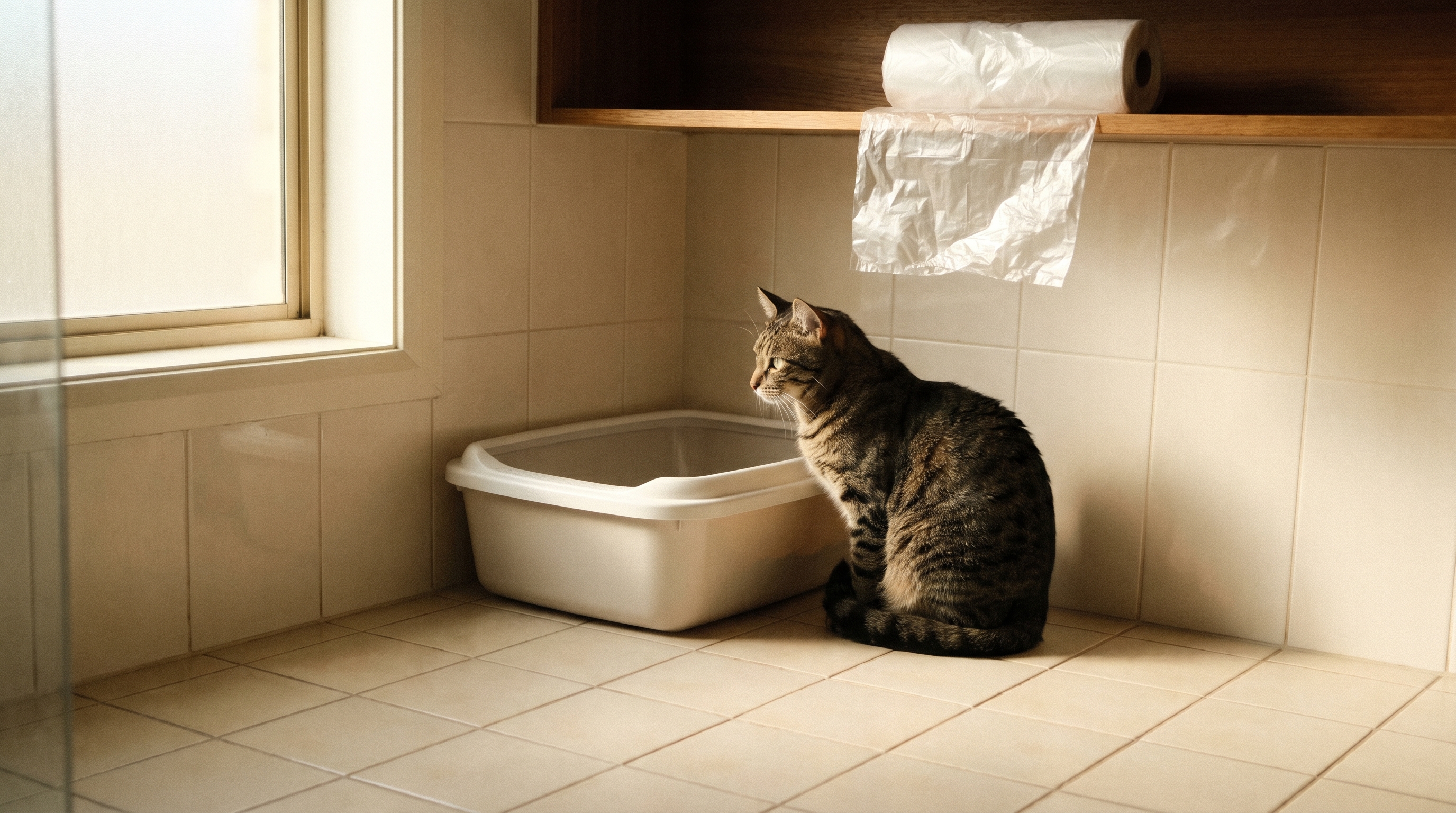
Litter bags are for the daily scoop. Tray liners are for the full box change. If you scoop every day and dump the whole box once a week or so, you want both. If you only ever scoop and top up, you can skip the liner. If you dump and refill often, the liner is the one that saves your knees and your nose.
The two jobs in a litter routine
Every litter box has two cleaning jobs, and they need different bags.
- The daily scoop. Clumps and poop come out, go into a bag, bag gets tied and binned. A small job you do a lot.
- The full change. Every one to four weeks (more often with several cats), all the litter comes out, the box gets washed, and fresh litter goes in. A big, heavy, gross job you do less often.
A litter bag is built for the first job. A tray liner is built for the second.
Cat litter bags: for the daily scoop
A litter bag is a large, strong bag you hold open while you scoop. The scoop goes straight from box to bag, so nothing trails across the floor. Tie it, bin it, done.
What to look for:
- Size. A standard dog poop bag is too small for a litter scoop. You want a bag wide enough to get a full scoop in without shaking litter off the edges. Roughly 12 by 18 inches is the sweet spot for one scoop per bag, or a full day of clumps in a multi-cat home.
- Strength. A day's worth of wet clumps is heavy. Cheap thin bags stretch, then split at the bottom on the way to the bin. Look for an extra-thick bag rated leakproof.
- Handles. Handles let you carry the bag closed and hang it on a hook by the box between scoops. A bag with handles also ties shut in one motion, which matters when your other hand is holding a scoop.
- Easy to open. Static-stuck bags that will not open one-handed are the fastest way to give up on the whole system.
Litter bags also do double duty. The same bag handles a large-breed dog pickup in the yard, or a diaper-bag-sized mess in the car.
Tray liners: for the full change
A tray liner is a big sheet-shaped bag you lay in the empty box before the litter goes in. On change day you lift the corners, pull the drawstring, and the whole load comes out in one piece. The tray underneath stays clean, so there is nothing to scrape.
What to look for:
- Fit. Measure your box. A liner needs to cover the base, run up all four sides, and fold over the rim with room to spare. For jumbo and extra-large boxes, about 36 by 19 inches works. A liner that is too small slides down the sides and litter gets under it, which defeats the point.
- Thickness. Cats dig. A thin liner gets punctured in the corners within a week. Look for 2 mil or thicker.
- A drawstring. Liners without one have to be gathered by hand while the litter shifts around inside. A built-in drawstring cinches the load shut, holds in loose litter and smell, and gives you a handle to carry it.
Which one do you need?
| Your routine | Get this |
|---|---|
| Scoop daily, full change every week or two | Both. Bags for the scoop, liners for the change. |
| Scoop daily, rarely dump the whole box | Litter bags only. |
| Non-clumping litter, dump the whole box often | Tray liners first. Add bags if you also scoop solids. |
| Several cats, several boxes | Both, and buy the bigger packs. |
| Cat who digs hard in the corners | Liners, doubled up. See below. |
Do cat claws tear tray liners?
Sometimes. A normal scratch-and-bury cat will not get through a 2 mil liner. A cat who rakes the base of the box on every visit can wear a hole in a corner over time.
The fix is to stack two liners. The outer one catches anything that gets through the inner one. You use more liners per change, but a double-liner change still beats scrubbing soaked litter off the bottom of the tray.
Do litter bags leak with wet clumping litter?
Thin ones do. A full scoop of clumping clay is wet and heavy, and wood pellet and tofu litters hold even more moisture. A bag rated leakproof and thick enough (around 18 microns for a litter bag) will hold a full day of clumps without weeping at the seams. If your current bag feels soft and stretchy when empty, that is fine. If it feels soft and stretchy when full, that is a warning.
Where does used litter go?
In the trash, tied shut. Not down the toilet. Clumping litter sets like cement in pipes, and cat feces can carry Toxoplasma gondii, a parasite that water treatment does not reliably remove. Tie the bag, put it in your household bin, and wash your hands. That is the whole routine.
If smell is the problem, the fix is a tighter closure, not a different bin. A drawstring liner or a handled bag tied shut holds smell in far better than an open grocery bag knotted at the top.
How GIVE A SH!T® litter bags and liners fit
Need a bag that holds up? GIVE A SH!T® extra-large cat litter bags are extra thick, leakproof, easy to open and tie, and have handles for carrying. They come in packs of 30, 60, or 90. Our tray liners are 36 by 19 inches, 2 mil thick, with a built-in drawstring, sized for jumbo and extra-large boxes, in packs of 10, 20, or 30. 10% of profits goes to the Soi Dog Foundation. Shop cat litter bags and liners.
Frequently asked questions
Can I use a regular grocery bag for litter?
You can, and most people start there. Grocery bags are thin, often have holes, and do not tie tight, so smell gets out and litter dust gets everywhere. A purpose-built litter bag with handles fixes all three.
Can I use a dog poop bag for cat litter?
For a single clump, yes. For a full scoop, it is too small and you will spill. Litter bags are roughly twice the size of a standard poop bag for this reason.
How often should I change the whole litter box?
With clumping litter and daily scooping, every two to four weeks. With non-clumping litter, weekly. With more than one cat per box, sooner. Your nose will tell you before the calendar does.
Do tray liners work with sifting or self-cleaning boxes?
Usually not. Sifting boxes need the litter to pass through a grate, and a liner blocks it. Self-cleaning boxes have rakes that snag on liners. Use litter bags for the daily output of those systems instead.
Will a liner stop litter from sticking to the bottom of the box?
Yes, if it fits. Wet litter sticks to the tray, not the liner, so a well-fitted liner lifts out clean and you skip the scraping step entirely.
Is this the same routine for a kitten?
Yes. Kittens make less mess but need the box kept just as clean, or they go elsewhere. If you are starting from scratch, see how to litter train a kitten.


